
Where to Start a Florida Number Search
Most government lookups begin at Florida 411, the official state telephone directory. The site offers one keyword box labeled Search State Employees, plus category tiles for Agencies, Employees, Counties, Public School Districts, Community and State Colleges, and Public Universities. It sits behind the main MyFlorida portal, which points residents to state services and the directory itself.
The Florida 411 directory looks like this from the home screen.
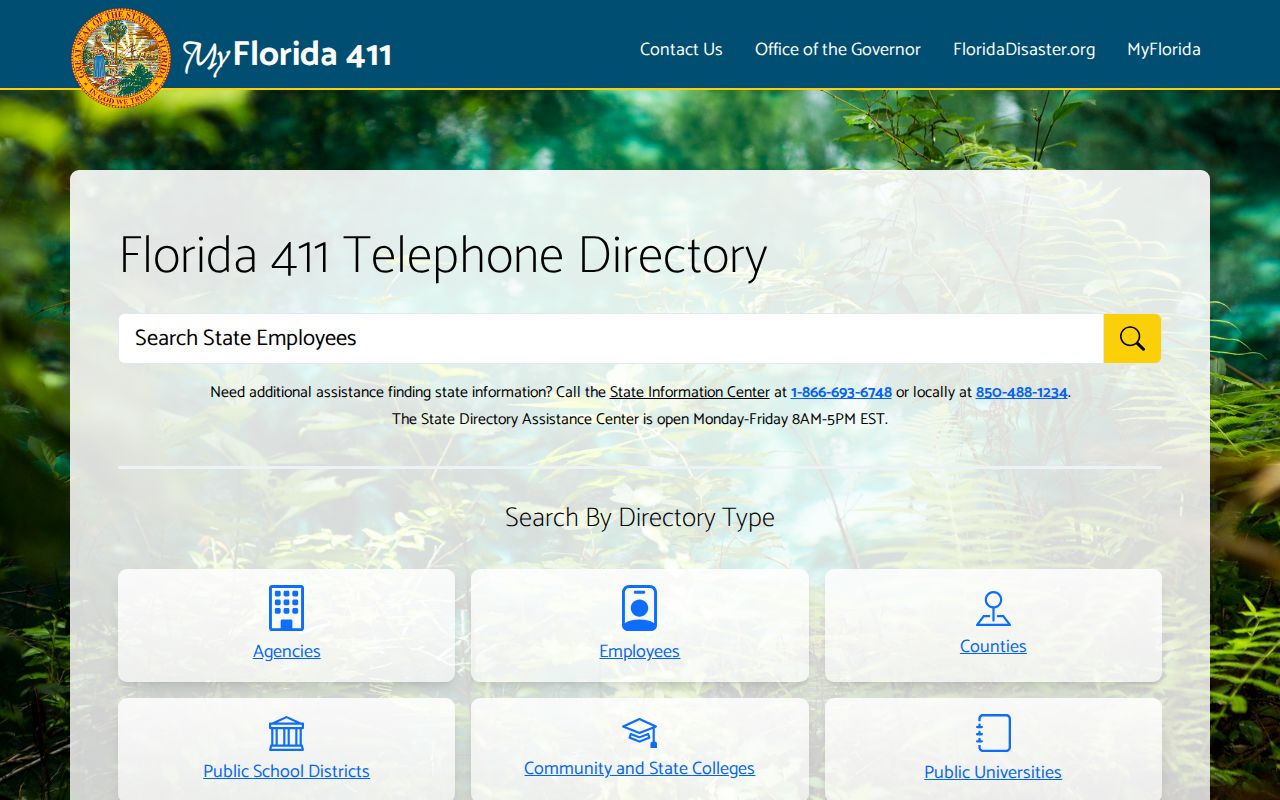
When the search box comes up empty, a human fallback exists. The State Information Center answers at 1-866-693-6748 or 850-488-1234, Monday through Friday, 8 AM to 5 PM Eastern. The order of operations depends on what you hold.
- Have a name? Run it through the Florida 411 employee search first, then narrow by agency if the results run wide.
- Have a task instead of a name? Go straight to the agency that owns it. FLHSMV handles driver and vehicle matters, FDLE handles law enforcement records, DOH handles health.
- Dealing with a county matter? Use the county's own site or the statewide clerk directories. Florida 411 has a Counties tile, but county sites run deeper.
- Got a call from a number you do not know? Work the reverse-lookup tools before you call back.
- Number not published anywhere? File a public records request with the agency's records custodian.
That last step has limits. Personal cell numbers of employees, protected investigative lines, victim and witness contacts, and student or health records can be exempt or redacted under Florida law.
Area Codes Across Florida
Florida runs 23 active area codes, more than almost any other state. The original code, 305, covered all of Florida in 1947. Decades of growth split it again and again, and the modern map reads as a set of regional identities. Miami keeps 305. The Space Coast dials 321. Tampa holds 813 while St. Petersburg answers on 727. Newer relief arrives as overlays, which add a second or third code to the same ground instead of redrawing lines.
Here is how the codes group by region, along with the local dialing that applies in each.
| Region | Area Codes | Local Dialing |
|---|---|---|
| Miami-Dade County and the Florida Keys | 305, 786, 645 | 10-digit |
| Broward County (Fort Lauderdale, Hollywood) | 954, 754 | 10-digit |
| Palm Beach County | 561, 728 | 10-digit |
| Orlando metro and Space Coast | 407, 321, 689 | 10-digit |
| Tampa and Hillsborough County | 813, 656 | 10-digit |
| Pinellas County and coastal Pasco | 727 | 7-digit |
| Jacksonville and Northeast Florida | 904, 324 | 10-digit |
| Panhandle and Big Bend | 850, 448 | 10-digit |
| Southwest coast (Fort Myers, Naples) | 239 | 7-digit |
| Gainesville, Ocala, The Villages | 352 | 10-digit |
| Daytona Beach and north-east interior | 386 | 7-digit |
| Treasure Coast (Port St. Lucie, Vero Beach) | 772 | 7-digit |
| Lakeland, Winter Haven, Sebring | 863 | 7-digit |
| Sarasota, Bradenton, Port Charlotte | 941 | 10-digit |
The Florida Public Service Commission tracks every one of these codes and posts area-code summaries for the state.
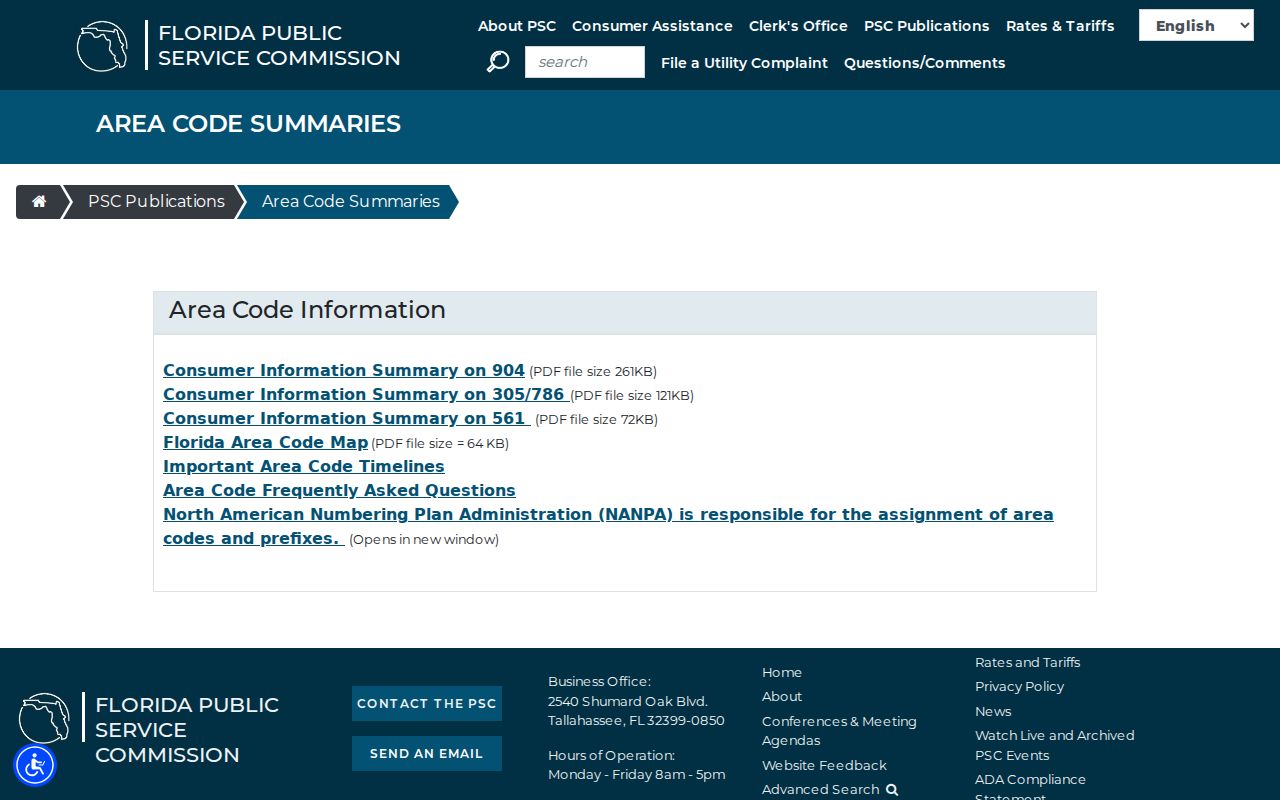
The PSC page is the official state record of which code covers which counties and when each overlay took effect.
Emergency and Crisis Numbers in Florida
Immediate danger always means 911. That covers crimes in progress, fire, serious injury, and any life-threatening situation. The Florida Highway Patrol adds a state-specific shortcut: from a mobile phone, *FHP (*347) reports crashes, drunk drivers, stranded motorists, and suspicious activity on the road. The 988 line is different. It reaches trained crisis counselors, not police dispatch.
911 - life-threatening emergency, fire, crime in progress, serious injury.
988 - Florida 988 Lifeline, 24/7 crisis support by call, text, or chat.
211 - Florida 211 community services, benefits help, and disaster referrals.
*FHP (*347) - Florida Highway Patrol roadway reporting from a mobile phone.
Poison Control - 1-800-222-1222.
Several statewide hotlines back these up. The Florida Abuse Hotline takes reports of child or vulnerable-adult abuse around the clock at 1-800-962-2873. FDLE's Missing Endangered Persons clearinghouse answers at 1-888-356-4774, and its sex offender registry line is 1-888-357-7332. During declared disasters, the State Assistance Information Line opens at 800-342-3557. National lines round it out: the Domestic Violence Hotline at 1-800-799-7233 and RAINN at 1-800-656-4673.
For highway patrol matters that are not urgent, the FHP station table lists every post statewide with its city, phone, county, and troop.
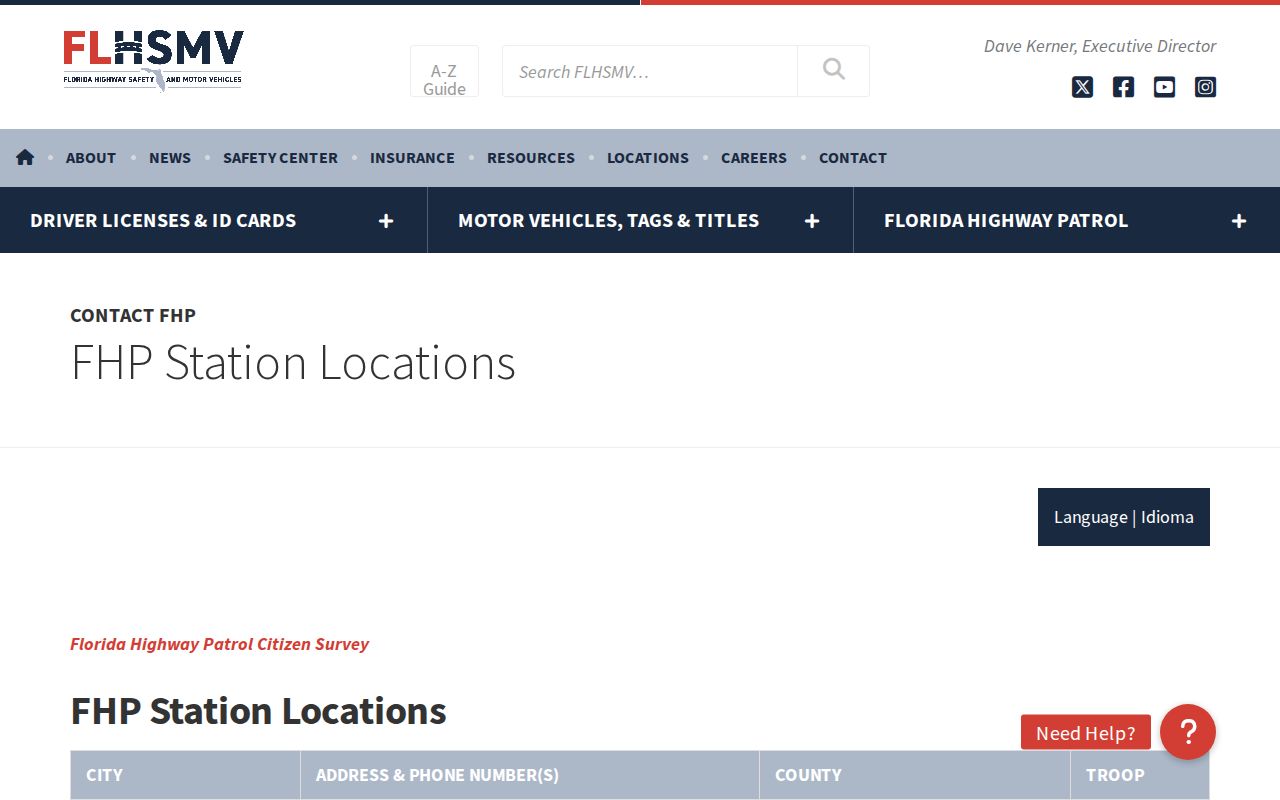
Sample rows show why the table matters: Jacksonville answers at 904-695-4000 under Troop G, Miami at 305-470-2500 under Troop E, Tampa at 813-558-1800 under Troop C, and Orlando at 407-737-2300 under Troop D.
Florida State Government Phone Directory
Because this is a statewide directory, the anchor is the state government itself rather than one city hall. Florida 411 carries the employee and agency listings, and its footer holds a warning worth knowing. Under Florida law, email addresses sent to state agencies are public records. Anyone who does not want an address released in a records request should contact the office by phone or in writing instead.
The directory search itself is simple. These are the working parts.
| Field | Type | What It Does |
|---|---|---|
| Search State Employees | Text box | Keyword search from the home page, submitted with a search icon button |
| Directory type | Tile links | Agencies, Employees, Counties, Public School Districts, Community and State Colleges, Public Universities |
Three contact points cover most general state questions.
State Information Center
Directory assistance for state government
Monday-Friday, 8 AM-5 PM ET
1-866-693-6748 or 850-488-1234
Governor's Citizen Services
Constituent help for Governor's office issues
850-488-7146
State Agency Lines Floridians Call Most
A handful of agencies field the bulk of calls. FLHSMV covers driver licenses, titles, and registrations at 850-617-2000, with a 24/7 self-service line at 850-617-3000. Crash report questions route to 850-617-3416, option 5. Keep the channels straight: *FHP is for roadway trouble, not license questions.
The Florida Department of Law Enforcement splits its lines by task. The headquarters number is 850-410-7000. Background and criminal history checks go to 850-410-8161, and the public records custodian answers at 850-410-7676. FDLE posts its commonly requested contacts on one page.
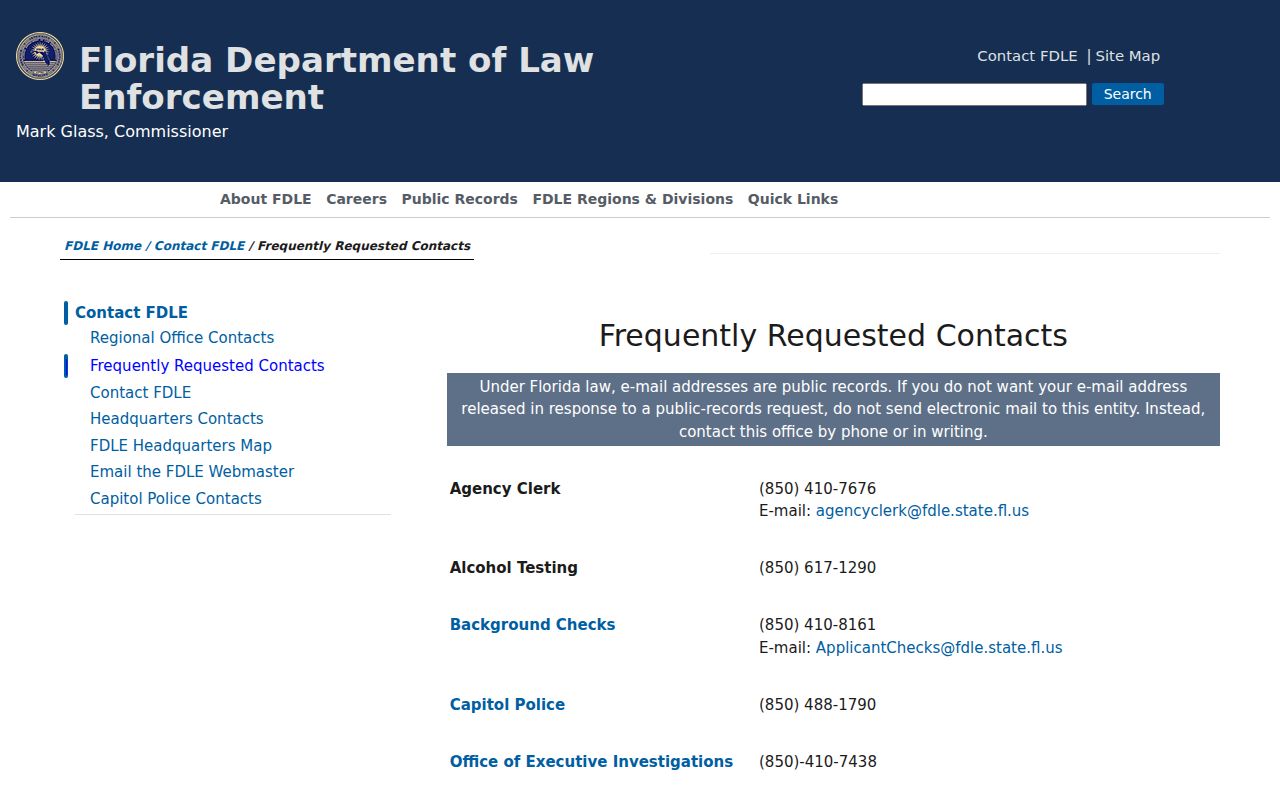
That page also carries the missing children and sex offender lines listed above, which saves a call to the switchboard. Other heavy hitters: the Public Service Commission's consumer assistance line at 1-800-342-3552 for utility and telecom complaints, the Department of Revenue at 850-488-6800 for tax help, the child support center at 850-488-KIDS (5437), and the Division of Emergency Management main line at 850-815-4000.
Note: Agency program lines close faster than switchboards, so a direct number from an agency contact page usually beats dialing the headquarters and asking for a transfer.
County Numbers Across Florida
Florida's 67 counties each keep their own sheriff, clerk of court, property appraiser, tax collector, elections supervisor, and health department. There is no statewide county switchboard. Two clerk directories cut through the spread: the Department of State's clerk list and the Florida Court Clerks and Comptrollers Find a Clerk search. A sample entry shows the level of detail: the Levy County Clerk in Bronson answers at 352-486-5266, extension 1222. Extension formats vary by county, so treat each listing on its own terms.
For health offices, the Department of Health runs a county health department locator with filters for county, address, distance, and services.
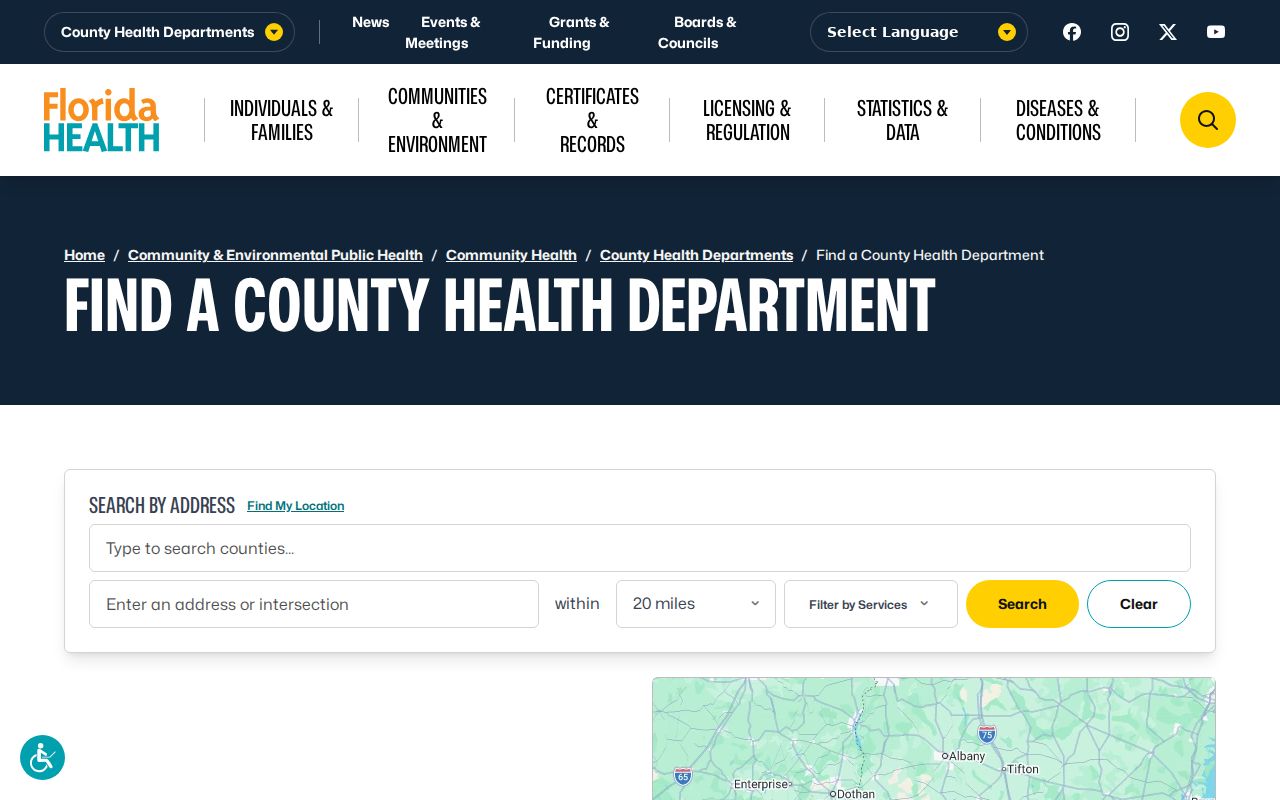
Every county has a health department reachable through that tool, which beats hunting 67 separate websites for a clinic or environmental health number.
Florida School and Library Phone Directories
Education numbers in Florida are unusually easy to find because the state publishes both an office phonebook and a school lookup. The Department of Education's office contacts page lists programs A to Z: the Commissioner's office at 850-245-0505, Educator Certification at 800-445-6739, and Bright Futures scholarships at 1-888-827-2004, among dozens more.
For an individual school, the FLDOE public school search works by school name or county and returns the address, school code, and phone for each building. Beyond K-12, the biggest campus and library switchboards include:
- University of Florida - 352-392-3261, with a public faculty and staff directory
- State University System - Board of Governors at 850-245-0466, with profiles of all state universities
- Miami Dade College - 305-237-8888
- Valencia College - 407-299-5000
- State Library of Florida - 850-245-6600, plus an A-Z list of public library systems
Utility and Outage Numbers in Florida
Utility calls split into two kinds, and mixing them up wastes time. Outages, downed lines, and gas odors belong on the emergency line, or on 911 first when life is at risk. Billing and account questions belong with customer service. If a regulated utility will not resolve a problem, the Public Service Commission takes complaints at 1-800-342-3552.
| Provider | Outage / Emergency | Notes |
|---|---|---|
| Florida Power & Light | 1-800-468-8243 | 911 first for life-threatening danger |
| Duke Energy Florida | 800-228-8485 | Or text OUT to 57801 |
| Tampa Electric | 877-588-1010 | Customer service 888-223-0800 |
| Peoples Gas | 911, then 877-832-6747 | Gas leak or odor |
| JEA (Jacksonville) | 904-665-6000 | Electric and water, 24/7 |
| OUC (Orlando) | 407-423-9018 | Or text OUT to 69682 |
| Sunshine 811 | 811 or 800-432-4770 | Call before any digging |
Digging projects start with one call. Sunshine 811 notifies every utility to mark buried lines for free, which beats phoning providers one by one.
Florida Health and Benefits Phone Lines
The Department of Health answers general questions at 850-245-4444. Birth, death, and marriage certificates route through Vital Statistics in Jacksonville at 904-359-6900. Local clinic and environmental health questions belong with the county health department found through the DOH locator above.
Benefits run through a different set of lines. The Department of Children and Families supports SNAP, cash assistance, and Medicaid applications at 850-300-4323, with TTY at 1-800-955-8771. Medicaid managed care enrollment answers at 1-877-711-3662, and the AHCA Medicaid helpline at 1-877-254-1055. WIC reaches families at 1-800-922-3936, and the Elder Helpline serves older Floridians at 1-800-963-5337.
Florida 211 and Community Help Lines
Dialing 211 works anywhere in the state. Florida 211 is a network of local centers that connects callers to food, housing, utility assistance, mental health referrals, and disaster resources.
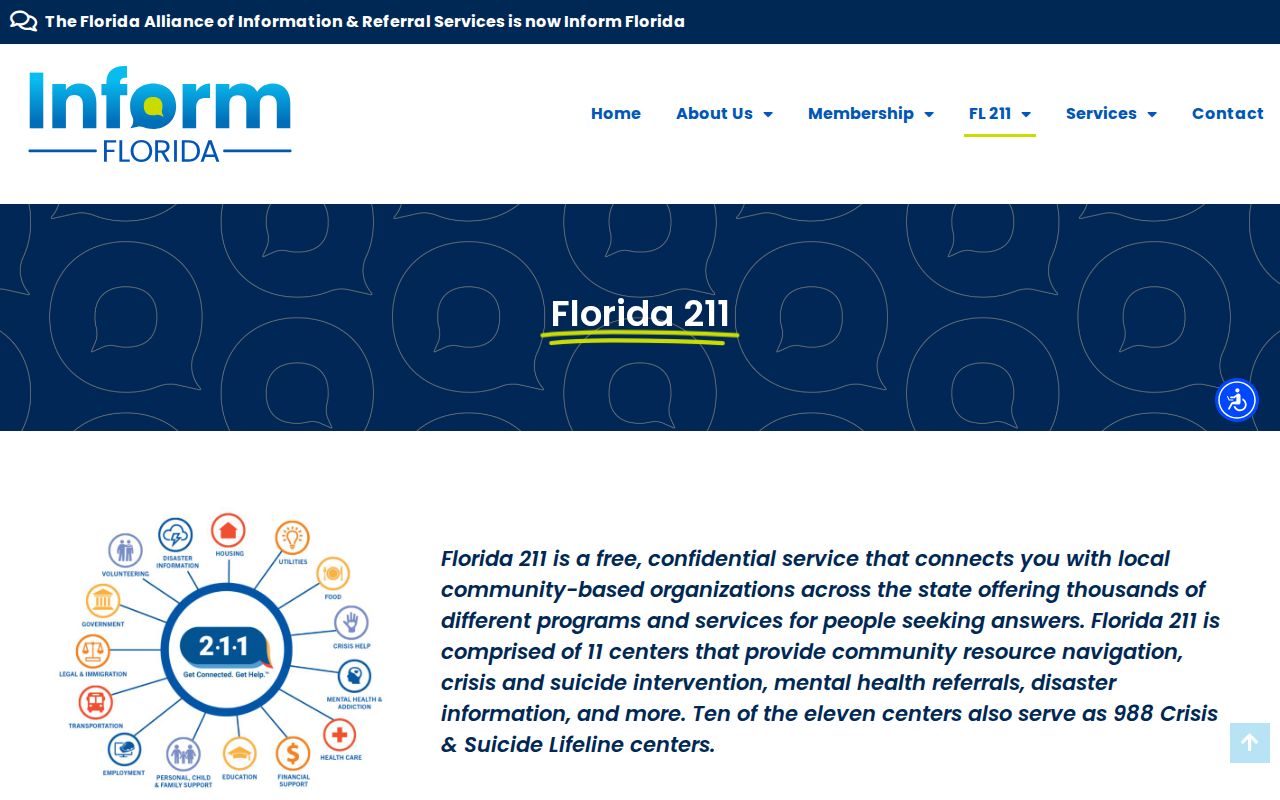
The network also runs an online side. The 211 search portal takes a plain-language need and a location and returns local programs with phone numbers.
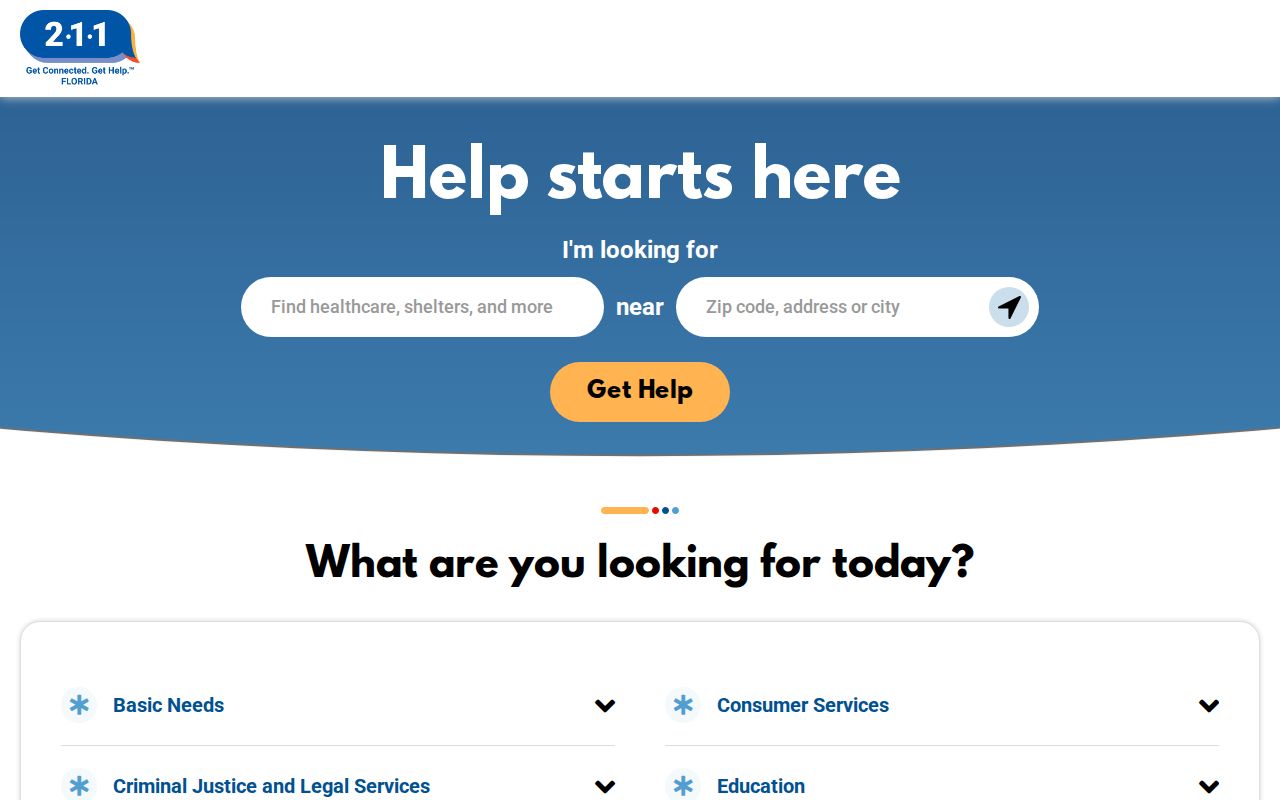
Typing what you need into the portal's search fields works even at 3 AM, when a phone specialist might have a wait. Language access is built into several Florida lines as well. Florida Relay 711 serves deaf and hard-of-hearing callers with a Spanish relay at 877-955-8773, the state's consumer services line offers Spanish help at 1-800-FL-AYUDA, and the FL511 traffic service runs fully bilingual.
Checking an Unknown Florida Number
A Florida area code on caller ID proves nothing. Mobile numbers travel with their owners, VoIP numbers get assigned from anywhere, and scammers spoof local digits on purpose. The safe habit is to hang up and call back through a number published on an official site or in Florida 411, never the number that just called. The complete workflow, tool by tool, sits with the Florida phone numbers reference.
| Tool | Type | What It Tells You |
|---|---|---|
| NANPA area code maps | Official | Which region a code actually belongs to |
| FCC Consumer Complaint Center | Official | Files robocall and spoofing complaints |
| Truecaller | Third-party | Crowdsourced caller names and spam labels |
| YouMail Directory | Third-party | Spam-number reports and caller labels |
| Carrier tools (ActiveArmor, Call Filter, Scam Shield) | Carrier | Scam and fraud labeling on your own line |
Common Florida Phone Scams
Utility shutoff threats top the list, especially in storm season when residents expect calls about power. Real utilities never demand gift cards, crypto, or wire transfers to stop a disconnection. Government impostors come next: callers spoofing courts, sheriffs, the IRS, or Medicare, plus jury-duty scams that demand payment to avoid arrest. Grandparent scams now use AI voice cloning, and hurricane recovery brings waves of fake contractors.
Reporting takes minutes. Register and complain at donotcall.gov or 1-888-382-1222, file spoofing reports with the FCC Consumer Complaint Center, and reach the Florida Attorney General at 1-866-966-7226. The state's consumer services division answers 1-800-HELP-FLA, with Spanish help at 1-800-FL-AYUDA. Before hiring any storm repair contractor, check the license through DBPR.
Storm Season Phone Numbers
Hurricanes change which numbers matter. Roads and evacuations run through 511. Shelter, food, and recovery help run through 211. Power hazards go to the utility outage lines above. For state-level assistance information during a declared emergency, the line is 800-342-3557. Behind all of it sits the State Watch Office, the 24/7 reporting point for emergency-management incidents, at 1-800-320-0519 or 850-815-4001.
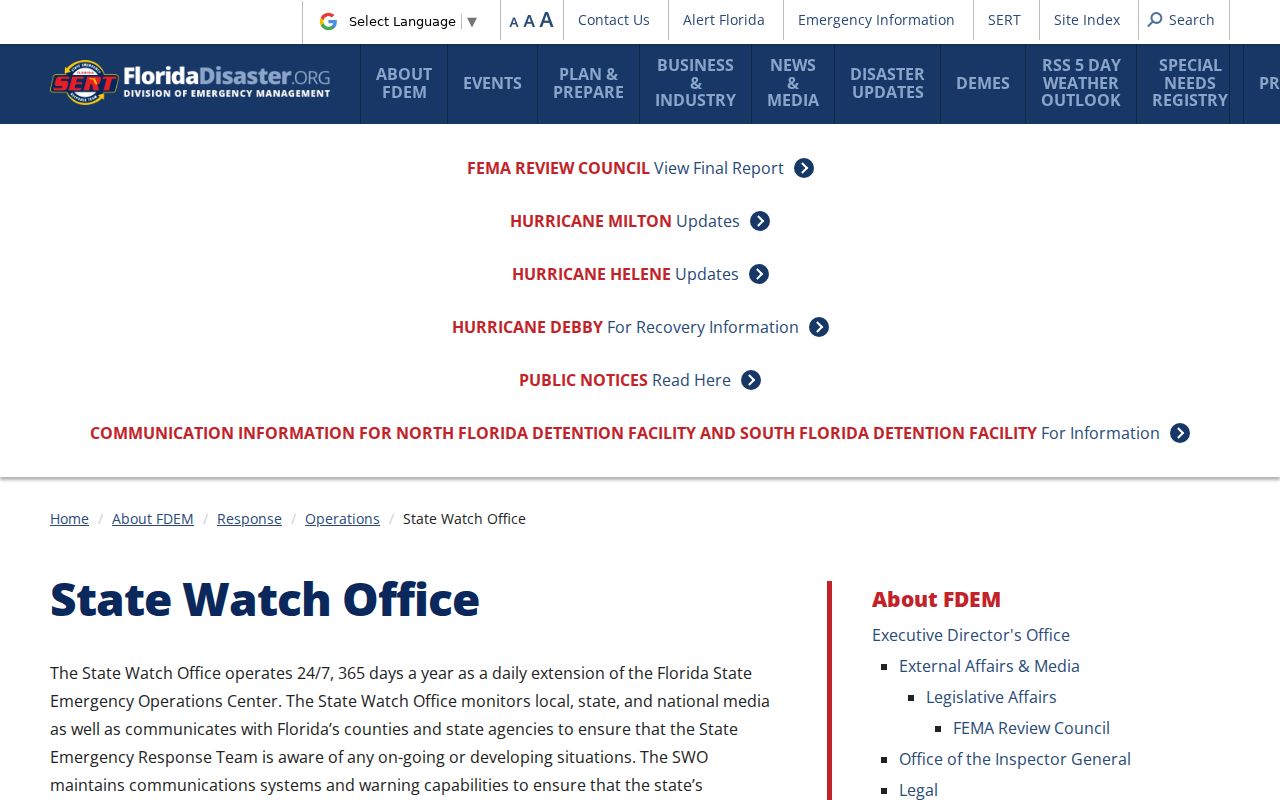
One caution rides along with every storm: scam calls spike after landfall. Keep the outage numbers saved before the season starts, and treat any unexpected utility call with suspicion.
Reading a Florida Phone Number
Every Florida number follows the North American pattern: a 3-digit area code, a 3-digit prefix, and a 4-digit line number, all under country code +1. What varies is the local dialing. Overlay regions require all 10 digits, while a few stand-alone codes still connect 7-digit calls. The N11 shortcuts, star codes, and toll-free prefixes each have their own rules, gathered in the Florida phone codes reference.
- NPA
- Numbering Plan Area - the 3-digit area code.
- NXX
- Central office / prefix code - the 3 digits after the area code.
- Overlay
- A second (or third) area code added to the same geography, requiring 10-digit dialing.
- Rate Center
- The telephone-billing geographic unit a prefix is assigned to.
The national numbering authority keeps the maps. NANPA's area-code map gateway covers every state, Florida included.
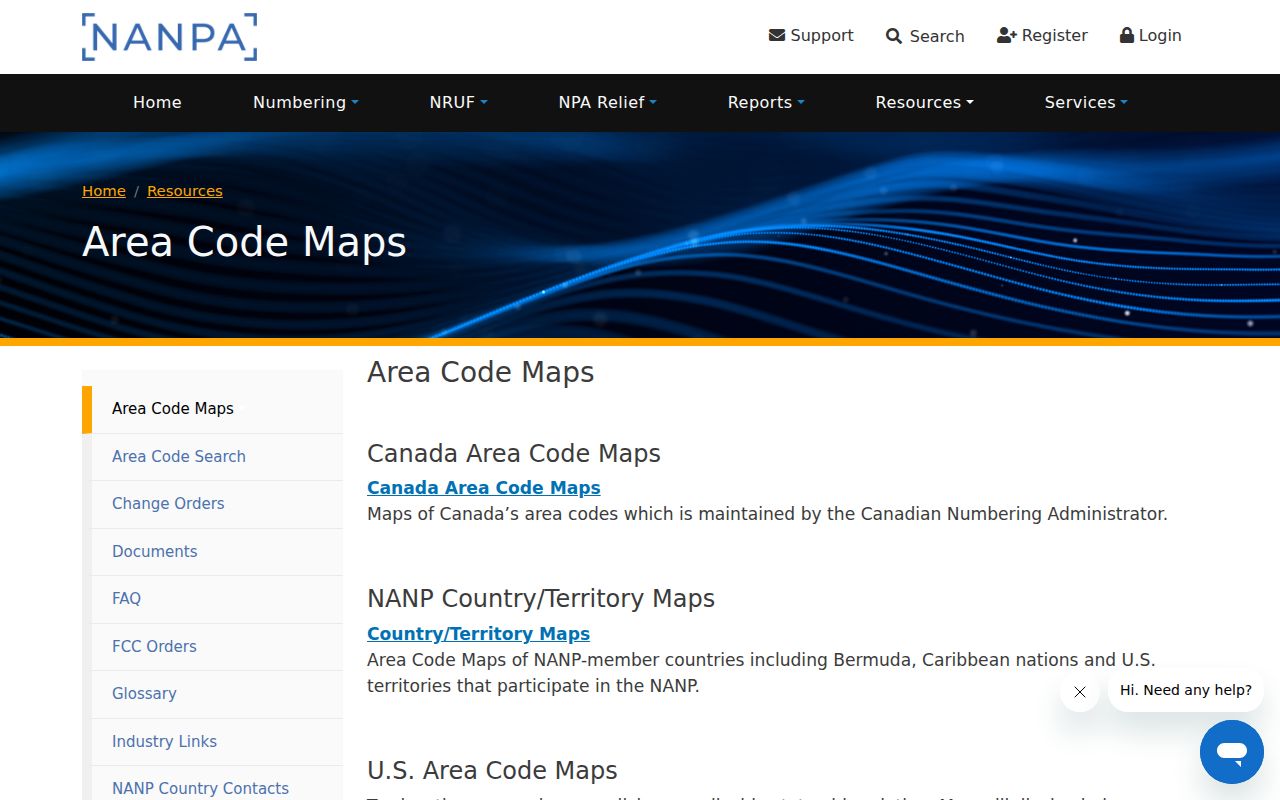
NANPA is where a code's official geography gets confirmed, which matters when a caller claims to be local.
How Florida Outgrew 305
In 1947, one code did everything. 305 stretched from Pensacola to Key West. Growth broke it apart in stages: 813 took the west coast in 1953, 904 took the north in 1965, and 407 took Orlando in 1988. Then the 1990s hit. Faxes, modems, business lines, and early cell phones burned through numbers, and Florida added 954, 941, and 352 in 1995, 561 in 1996, 850 in 1997, 786 and 727 in 1998, and 321 and 863 in 1999.
The 2000s brought 754, 386, 239, and 772. After that the splits stopped and the overlays began: 689 for Orlando in 2019, 448 for the Panhandle in 2021, 656 for Tampa in 2022, 728 for Palm Beach and 645 for Miami in 2023, and 324 for Jacksonville in 2024. On the wireline side, Southern Bell and later BellSouth served much of the state while GTE and other incumbents held other territories, so no single company ever ran all of Florida's phones.
Note: Old exchange history no longer predicts who serves a number today, since portability lets any number change carriers without changing digits.
Recent Florida Phone Changes
The newest shifts all involve overlays. Mandatory 10-digit dialing reached the 904 region on January 29, 2024, clearing the way for the 324 overlay across Jacksonville and Northeast Florida, per the PSC announcement. The 645 overlay went live for Miami-Dade and the Keys in late 2023, and 728 entered service for Palm Beach County in March 2023.
On the federal side, the FCC tightened its STIR/SHAKEN caller-ID authentication rules effective September 18, 2025, pushing providers to sign their own attestation decisions. No additional Florida relief codes have been announced beyond the three recent overlays.
Note: Dialing rules change through PSC orders and NANPA planning letters, so confirm the current rule before trusting older printed material.
Frequently Asked Questions
Do I have to dial the area code everywhere in Florida?
No. It depends on where you are. Overlay regions like Miami, Orlando, Tampa, Jacksonville, Broward, Palm Beach, and the Panhandle require all 10 digits, and 988-related orders added 352, 941, 561, and Brevard's 321 to that list. Five codes still accept 7-digit local calls: 239, 386, 727, 772, and 863.
How do I find a Florida state employee's phone number?
Start with the Search State Employees box on Florida 411. Narrow by agency if the name is common. If the search fails, call the State Information Center at 1-866-693-6748 during weekday business hours and ask for directory assistance.
Is there a statewide 311 in Florida?
No. 311 only works where a specific city or county operates it. Statewide, the short codes divide by purpose instead: 211 for community services, 511 for traffic, 711 for relay, 811 for digging, 911 for emergencies, and 988 for crisis support. Florida 411 handles government directory questions on the web.
Who handles a complaint about my electric or phone company?
Try the utility's own customer service first and write down dates and names. If that fails and the company is regulated, the Public Service Commission's consumer assistance line at 1-800-342-3552 takes the complaint from there.
A caller with a 305 number says they are my utility. Should I trust it?
Not on caller ID alone. Numbers spoof easily, and a real Florida agency may even call from a toll-free line. Hang up, find the published number on the utility's official page, and call that instead. Any demand for gift cards or wire payment means scam.
How do I cut down on robocalls?
Register your number at donotcall.gov or 1-888-382-1222, then report violators there after the registration period. File spoofing complaints with the FCC. Carrier apps like ActiveArmor, Call Filter, and Scam Shield block or label suspected spam before your phone rings.