
Area Codes Serving Florida
Florida has 23 active geographic area codes. That total grew from a single code, 305, which covered the whole state in 1947 and now serves only Miami-Dade County and the Keys. The rest arrived through decades of splits and, more recently, overlays. Eight metro regions now run overlay complexes where two or three codes share the same ground, while seven codes still stand alone.
The full picture fits in one table. Codes listed together on a row share the same territory.
| Area Code(s) | Coverage | Local Dialing | Background |
|---|---|---|---|
| 305 / 786 / 645 | Miami-Dade County and the Florida Keys | 10-digit | 305 original 1947; 786 overlay 1998; 645 overlay 2023 |
| 954 / 754 | Broward County: Fort Lauderdale, Hollywood, Coral Springs | 10-digit | 954 split from 305 in 1995; 754 overlay 2001 |
| 561 / 728 | Palm Beach County: West Palm Beach, Boca Raton, Delray Beach | 10-digit | 561 split 1996; 728 overlay in service 2023 |
| 407 / 321 / 689 | Orlando metro: Orange, Osceola, Seminole, Lake, parts of Brevard | 10-digit | 407 split from 305 in 1988; 321 added 1999; 689 overlay 2019 |
| 321 (Brevard) | Space Coast: Brevard County | 10-digit since 2021 | Assigned 1999 as a launch-countdown tribute |
| 813 / 656 | Tampa, Plant City, inland Pasco, Oldsmar | 10-digit since 2022 | 813 split from 305 in 1953; 656 overlay 2022 |
| 727 | Pinellas County and coastal Pasco: St. Petersburg, Clearwater | 7-digit | Split from 813 in 1998 |
| 904 / 324 | Jacksonville, St. Augustine, Northeast Florida | 10-digit since 2024 | 904 split from 305 in 1965; 324 overlay 2024 |
| 850 / 448 | Panhandle and Big Bend: Pensacola, Tallahassee, Panama City | 10-digit since 2021 | 850 split from 904 in 1997; 448 overlay 2021 |
| 239 | Fort Myers, Cape Coral, Naples, mainland Monroe | 7-digit | Split from 941 in 2002 |
| 352 | Gainesville, Ocala, Inverness, The Villages | 10-digit since 2021 | Split from 904 in 1995 |
| 386 | Daytona Beach, Lake City, Live Oak | 7-digit | Split from 904 in 2001 |
| 772 | Treasure Coast: Port St. Lucie, Vero Beach, Stuart | 7-digit | Split from 561 in 2002 |
| 863 | Lakeland, Winter Haven, Sebring, Clewiston | 7-digit | Split from 813 in 1999 |
| 941 | Manatee, Sarasota, Charlotte: Bradenton, Punta Gorda | 10-digit since 2021 | Split from 813 in 1995 |
Florida Area Codes by Region
Reading the map from south to north tells the story faster than any list of numbers. South Florida stacks three overlay complexes back to back: Miami-Dade and the Keys on 305, 786, and 645, then Broward on 954 and 754, then Palm Beach on 561 and 728. Central Florida belongs to the 407, 321, and 689 complex around Orlando, with 321 pulling double duty as the Space Coast's own code in Brevard County. Tampa Bay splits its identity down the middle of the bay: 813 and 656 on the Tampa side, 727 alone across Pinellas and coastal Pasco.
The rest of the state runs mostly on stand-alone codes. A quick regional key:
- Southwest Gulf coast - 239 covers Lee and Collier Counties plus mainland Monroe, from Cape Coral down through Naples and Everglades City
- Sarasota-Bradenton coast - 941 runs the Gulf shore south of Tampa Bay through Manatee, Sarasota, and Charlotte Counties
- North-central interior - 352 takes Gainesville, Ocala, Dunnellon, Spring Hill, and The Villages
- Northeast corner - 904 and its 324 overlay reach all or most of Nassau, Duval, Baker, Bradford, Clay, St. Johns, and Union Counties
- North and east interior - 386 stretches from Daytona Beach inland to Lake City and Live Oak
- Inland ridge - 863 covers the citrus and lake country from Lakeland to Arcadia and Clewiston
- Panhandle - 850 and 448 share everything from Pensacola across the Big Bend to Tallahassee
Overlay vs Split in Florida
Florida has used both relief methods, in two distinct eras. From 1953 through 2002, the state split codes: a new code took part of the old territory, and everyone inside the new boundary changed numbers. Since 2019, every new Florida code has been an overlay instead. An overlay lays the new code over the exact same ground, nobody changes numbers, and the trade-off is that every local call needs all ten digits.
- Overlay
- A second (or third) area code added to the same geography. Everyone keeps their existing number. Mandatory 10-digit dialing applies to all calls.
- Split
- The old area code keeps part of the geography. The new area code takes another part. People in the new region get new numbers.
- Permissive Dialing
- The transition period when both old (7-digit) and new (10-digit) calls connect. Ends on a fixed cutover date.
The switch to overlays explains why recent changes felt painless compared to the old splits. When 656 arrived in Tampa, no business reprinted letterhead. When 941 split from 813 back in 1995, whole counties got new numbers overnight.
Which Florida Codes Need 10 Digits
There is no single Florida dialing rule. The NANPA 2024 Annual Report lists the state as a patchwork: 7-digit local dialing still works in 239, 386, 727, 772, and 863, while every overlay complex requires 10 digits. Two forces drove the 10-digit conversions. Overlays force it by definition, since two codes share one territory. The 988 crisis line forced it elsewhere: the FCC moved 352, 561, 941, and Brevard's 321 to mandatory 10-digit dialing on October 24, 2021, because those codes contained 988 as a working prefix. PSC orders set the remaining dates: May 22, 2021 for 850 and 448, January 22, 2022 for 813 and 656, and January 29, 2024 for 904 and 324.
Important: In 18 of Florida's 23 area codes, 7-digit local calls no longer connect. When in doubt anywhere in the state, dial all 10 digits. That always works.
Dialing goes deeper than the area code, of course. The N11 shortcuts, star codes, and the +1 country code all follow their own rules, collected in the Florida phone codes reference.
The Florida Public Service Commission issues these dialing orders and posts consumer guidance through its main site.
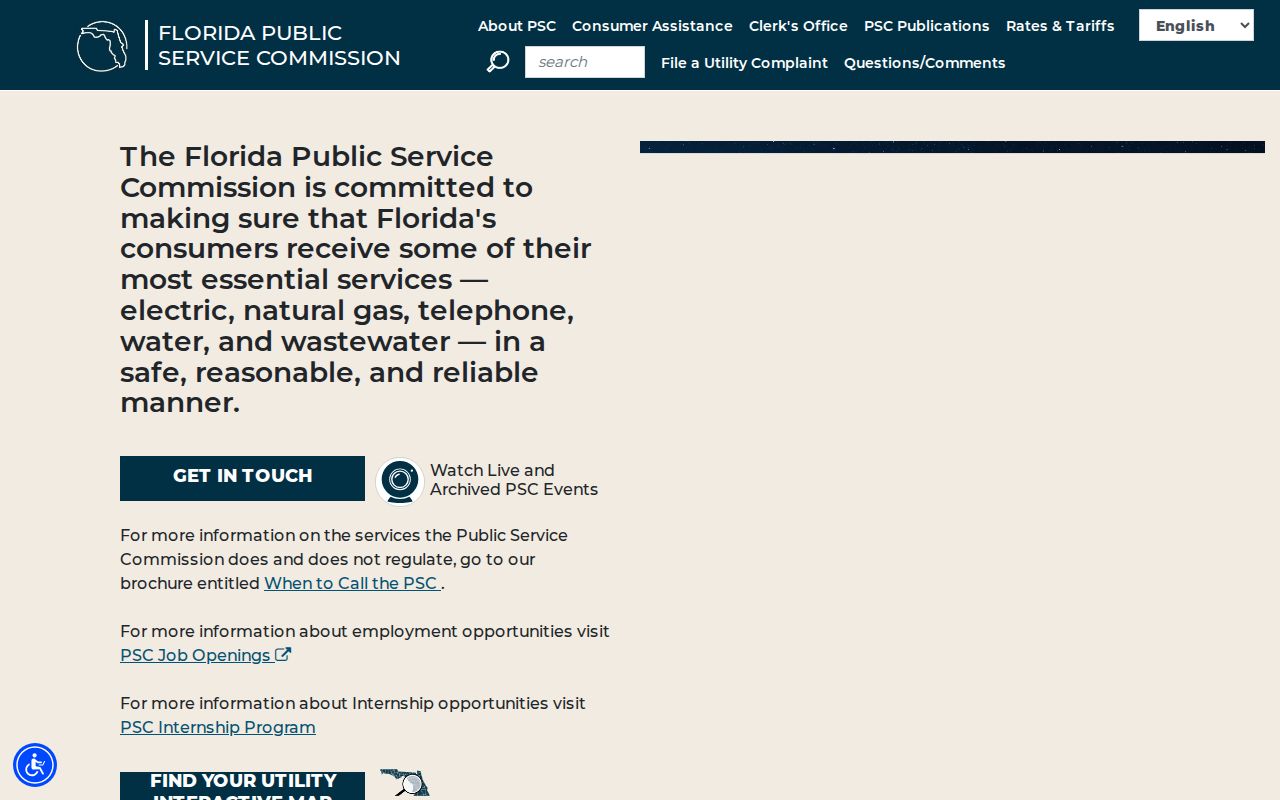
PSC pages are the state-level source of record whenever a dialing deadline or overlay date needs confirming.
History of Florida Area Codes
The timeline splits cleanly into three chapters. First came the slow era: one new code roughly every decade as 813, 904, and 407 carved regions out of 305. Then the 1990s boom packed nine new codes into five years, driven by population growth, fax machines, modems, and early cell phones. The third chapter is the overlay era, which is still running.
| Year | Event |
|---|---|
| 1947 | 305 assigned as Florida's original statewide area code |
| 1953 | 813 split from 305 for west and coastal Florida |
| 1965 | 904 split from 305 for northern Florida |
| 1988 | 407 split from 305 for Orlando and east-central Florida |
| 1995 | 954 (Broward), 941 (from 813), and 352 (from 904) all arrive in one year |
| 1996 | 561 split from 407 for Palm Beach and the Treasure Coast |
| 1997 | 850 split from 904 for the Panhandle and Big Bend |
| 1998 | 786 overlays Miami-Dade; 727 splits from 813 for Pinellas |
| 1999 | 321 launches on the Space Coast; 863 splits from 813 |
| 2001 | 754 overlays 954; 386 splits from 904 |
| 2002 | 239 splits from 941; 772 splits from 561; the split era ends |
| 2019 | 689 overlay activates in the Orlando 407/321 complex |
| 2021 | 448 overlays 850; 988-driven 10-digit dialing hits four more codes |
| 2022 | 656 overlays 813 in the Tampa region |
| 2023 | 728 overlays 561; 645 overlays 305/786 |
| 2024 | 324 overlays 904 across Northeast Florida |
A few codes carry stories beyond the dates. 321 was assigned to Brevard County on purpose, echoing a rocket launch countdown for the Space Coast. And 305 has outlived its statewide role to become shorthand for Miami itself, even though 786 and 645 now share the same streets.
Local Exchange Prefixes in Florida
The three digits after the area code, called the NXX or central office code, once pointed to a physical switching office and still map to rate centers for billing. With thousands of Florida prefixes in service, no one memorizes them. What matters is the caveat: number portability means a prefix no longer proves which carrier serves a number today. Institutional blocks are the exception that proves the rule, like the University of Florida's numbers clustering under 352-392. The deeper prefix explanation, including thousands-block pooling, lives with the Florida phone codes reference linked above.
New Florida Area Codes on the Horizon
Nothing new is currently announced. The three most recent overlays, 728 for Palm Beach, 645 for Miami-Dade and the Keys, and 324 for Northeast Florida, are expected to supply numbers in their regions for years. NANPA reviews number exhaust forecasts on a rolling basis, so the picture can change, but no additional Florida relief project has been identified beyond those three.
When the next code does come, the process is predictable. NANPA files a relief plan, the Florida PSC approves the method and the dates, permissive dialing gives residents a grace period, and then 10-digit dialing becomes mandatory before the new code activates. The 904 and 324 rollout followed exactly that script.
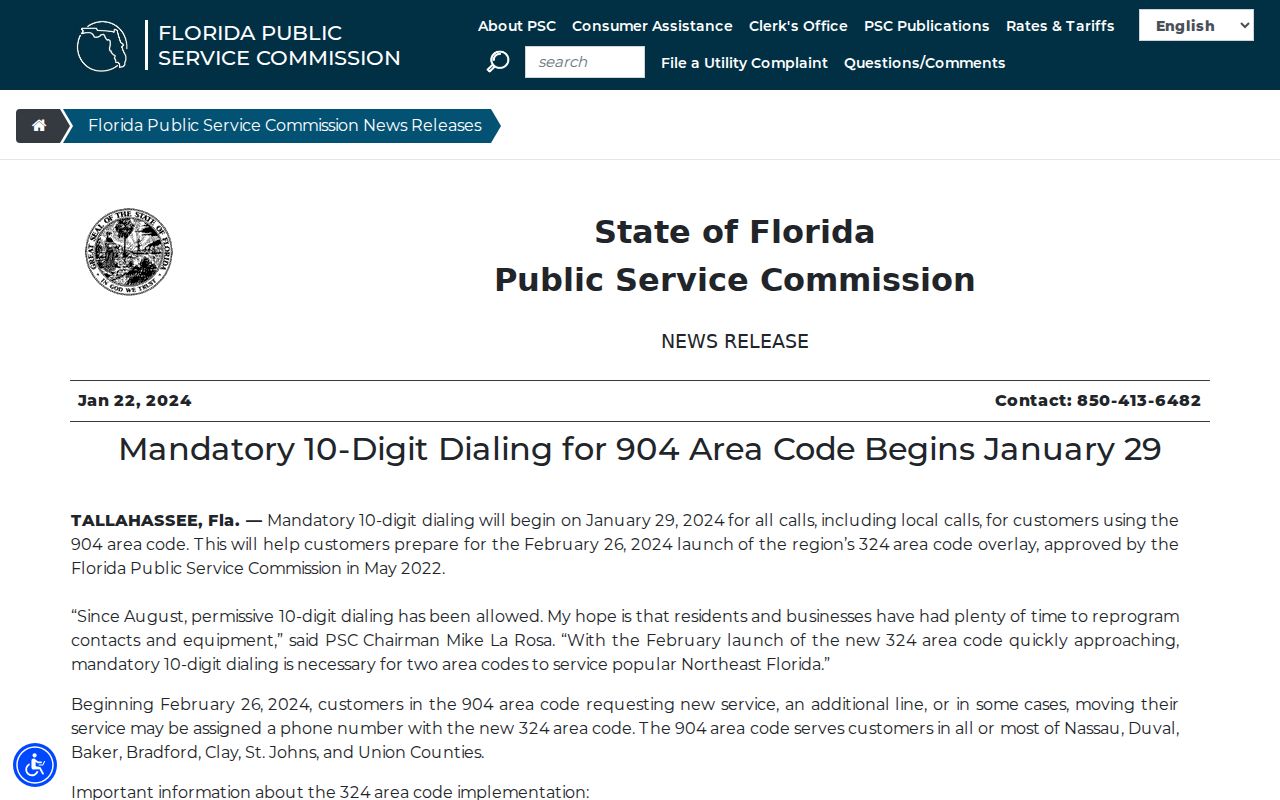
Residents rarely need to do anything beyond updating saved contacts to 10-digit format. Existing numbers never change in an overlay.
Note: Overlay start dates shift between the original order and the final cutover, so treat any date more than a year old as provisional until checked.
Verifying a Florida Area Code
Two national sources settle any question about whether a code is real and where it belongs. NANPA publishes the official area-code maps and runs a planning-letter index that documents every relief project, searchable by state, year, or code. The FCC's consumer guide explains the 10-digit dialing transition and the 988 connection. Checking takes a minute and catches the fake codes scammers sometimes invent.
For the paper trail behind any Florida code, the NANPA planning-letter search filters by year, letter number, code, or state.
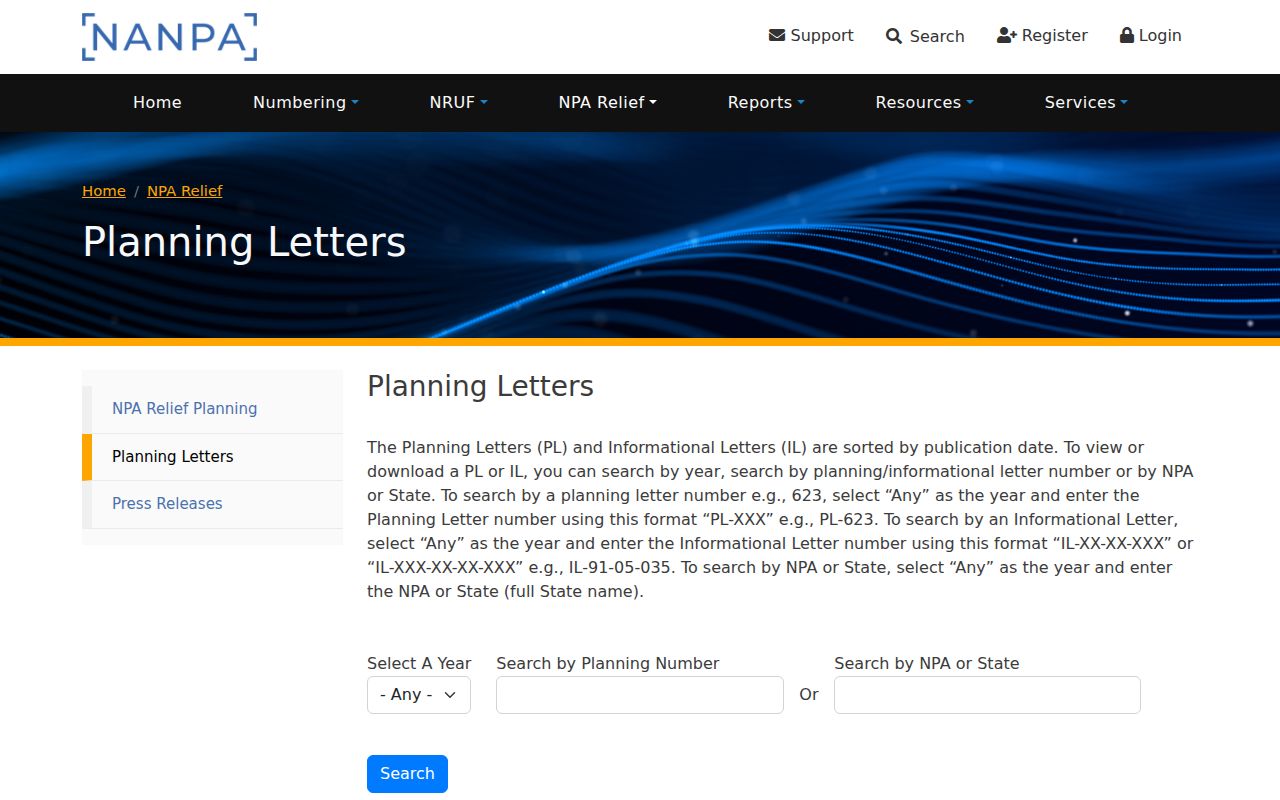
Planning letters are where overlay boundaries and cutover dates get published first, ahead of news coverage.